
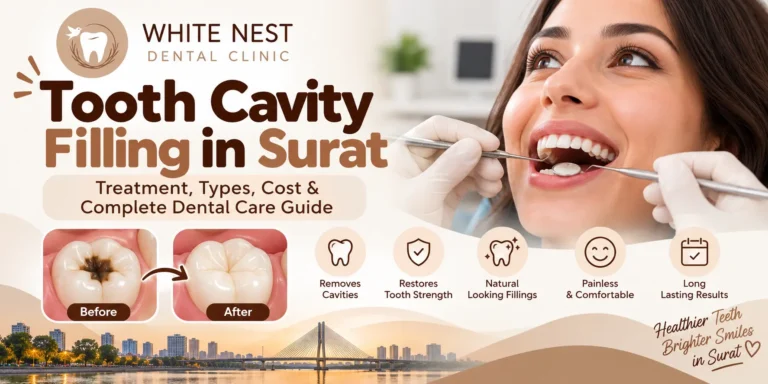
A small cavity may not seem like a serious dental problem, especially when it does not cause pain. However, untreated tooth decay can gradually damage the enamel, reach the inner layers of the tooth and eventually require more complex dental treatment. Getting the problem checked early can help preserve more of your natural tooth structure.
If you are looking for tooth cavity filling in Surat, understanding the treatment process, available filling materials, symptoms and approximate costs can help you make an informed decision. At White Nest Dental Clinic, patients from Adajan and nearby areas can seek a dental assessment to understand the condition of their teeth and the appropriate treatment options.
Whether you have tooth sensitivity, a visible dark spot, food getting stuck between your teeth or discomfort while chewing, a dental examination can help determine whether you need a simple filling or another form of treatment.
What Is a Tooth Cavity?
A tooth cavity is a permanently damaged area that develops when bacteria in dental plaque produce acids that gradually weaken the tooth structure. This process is known as dental caries or tooth decay.
Your teeth have several layers. The outer enamel protects the tooth, while the dentin underneath is softer and more sensitive. Beneath the dentin is the pulp, which contains nerves and blood vessels.
When decay is limited to a small area, a dentist may be able to remove the damaged portion and restore the tooth using a dental filling. If decay progresses deeper and affects the pulp, additional treatment such as root canal therapy may be necessary.
Early diagnosis is important because not every cavity causes noticeable pain in its initial stages.
10 Common Signs You May Need Tooth Cavity Filling Treatment
Cavities can develop without obvious symptoms. However, certain changes in your teeth may indicate that you should schedule a dental check-up.
1. Sensitivity to Hot and Cold Foods
If you experience a sharp or uncomfortable sensation while drinking cold water, tea or hot beverages, tooth decay may be one possible reason. Sensitivity can also occur due to gum recession, enamel erosion and other dental conditions.
2. Toothache or Occasional Pain
A mild toothache that appears while eating or drinking may indicate developing decay. Persistent or worsening pain requires prompt dental assessment.
3. Dark Spots or Visible Holes
Brown, black or dark spots on a tooth may indicate decay, although not every dark mark is a cavity. A dentist can examine the affected area and determine whether treatment is required.
4. Food Frequently Getting Stuck Between Teeth
If food repeatedly gets trapped in the same area, there may be a cavity between two teeth, a damaged filling or another issue that needs examination.
5. Pain While Chewing
Discomfort when biting or chewing food may indicate tooth decay, a cracked tooth, a damaged restoration or another dental problem.
6. Rough or Damaged Tooth Surface
A cavity may create an uneven surface or a small hole that you can notice with your tongue. Avoid trying to clean or inspect the hole using sharp objects.
7. Bad Breath or Unpleasant Taste
Food particles and bacterial buildup around damaged teeth can contribute to bad breath. Persistent bad breath should be assessed because it can have several possible causes.
8. Sensitivity to Sweet Foods
Pain or sensitivity after eating chocolates, sweets or sugary foods may be associated with exposed dentin or tooth decay.
9. A Previous Filling Has Fallen Out
A loose, chipped or missing dental filling can expose the underlying tooth structure. It should be examined so the dentist can decide whether it needs replacement or another restoration.
10. No Symptoms but Decay Appears During a Check-Up
Some cavities are detected during routine dental examinations or dental X-rays before they cause pain. This is one reason regular dental check-ups are important.
What Causes Tooth Cavities?
Tooth decay usually develops through a combination of bacteria, dietary habits and inadequate oral hygiene. Some common contributing factors include:
- Frequent sugar consumption: Sugary snacks and drinks provide fuel for cavity-causing bacteria.
- Poor brushing habits: Inadequate brushing allows plaque to accumulate on tooth surfaces.
- Not cleaning between teeth: Food particles and plaque can remain between teeth where a toothbrush may not reach effectively.
- Frequent snacking: Repeated exposure to sugars and fermentable carbohydrates increases acid attacks on the teeth.
- Dry mouth: Reduced saliva can affect the mouth’s natural ability to neutralise acids and clear food particles.
- Deep tooth grooves: Some molars have pits and grooves where plaque can accumulate.
- Existing dental problems: Damaged fillings, exposed root surfaces and previous restorations may require additional attention.
Good oral hygiene and preventive dental visits can reduce the risk of cavities, but they cannot guarantee that decay will never develop.
When Do You Need a Dental Cavity Filling?
A dental filling may be recommended when tooth decay has created a cavity that requires restoration.
During an examination, the dentist checks the affected tooth, assesses the extent of damage and may recommend an X-ray if the decay is not clearly visible or appears to extend between teeth.
A filling may be suitable when:
- The cavity is limited to the enamel or dentin.
- The affected tooth has enough healthy structure to support a restoration.
- The pulp is not irreversibly damaged or infected.
- The damaged portion can be cleaned and restored appropriately.
If decay has progressed significantly, a simple filling may not be sufficient. Your dentist may discuss other options based on the tooth’s condition.
Types of Dental Fillings Used for Cavity Treatment
The choice of dental filling material depends on the location of the cavity, its size, the amount of remaining tooth structure, functional requirements and aesthetic preferences.
1. Composite or Tooth-Coloured Filling
Composite fillings are made from a resin-based material that can be matched to the natural shade of your teeth.
They are commonly used for visible teeth and suitable cavities in both front and back teeth. The material is bonded to the tooth and shaped to restore its appearance and function.
Potential advantages:
- Natural-looking appearance.
- Available in different shades.
- Bonds to the prepared tooth structure.
- Suitable for many small and moderate cavities.
Composite fillings may require replacement over time due to wear, chipping or recurrent decay.
2. Glass Ionomer Cement (GIC) Filling
Glass ionomer cement is another restorative material used in selected dental situations. It can release fluoride and may be suitable for certain cavities, particularly in areas where aesthetic or functional demands differ.
Potential advantages:
- Fluoride release.
- Can be useful in selected paediatric and restorative cases.
- Bonds chemically to tooth structure.
- May be considered for certain areas near the gumline.
GIC may not be the preferred option for every cavity, particularly where the restoration must withstand heavy chewing forces.
3. Amalgam Filling
Dental amalgam is a metal-based restorative material that has historically been used for filling cavities, particularly in back teeth.
It is durable in many situations but does not match the natural colour of teeth. Its use may also be affected by patient-specific considerations and applicable local regulations or recommendations.
4. Temporary Dental Filling
A temporary filling is used when the dentist needs to protect a tooth for a limited period before completing further treatment.
It may be placed between appointments, during certain root canal procedures or while the dentist monitors a particular condition.
A temporary filling should not automatically be considered a permanent solution. Follow the dentist’s instructions about the next appointment and final restoration.
Tooth Cavity Filling Procedure: Step-by-Step
Many patients feel nervous before visiting a dentist because they are unsure what happens during a cavity filling. The process is generally straightforward when the decay is limited and the tooth is suitable for restoration.
Step 1: Dental Examination
The dentist examines the affected tooth, checks for visible decay and assesses your symptoms. Dental X-rays may be recommended when necessary to evaluate decay between teeth or its depth.
Step 2: Local Anaesthesia, If Required
Depending on the cavity’s location and depth, local anaesthesia may be used to make the procedure more comfortable.
Some small restorations may not require anaesthesia, but this decision depends on the individual case.
Step 3: Removal of Decayed Tooth Structure
The dentist carefully removes the damaged portion of the tooth while preserving as much healthy structure as possible.
Step 4: Cleaning and Preparation
The prepared area is cleaned and made suitable for the selected filling material. For composite restorations, bonding materials may be applied according to the manufacturer’s instructions and the dentist’s technique.
Step 5: Placement of the Filling
The selected dental filling material is placed into the prepared cavity. Composite material is generally applied in layers and hardened using a special curing light.
Step 6: Shaping and Bite Adjustment
The dentist shapes the restoration to match the natural contours of the tooth and checks how your upper and lower teeth meet when you bite.
Step 7: Final Polishing
The filling is polished to improve its surface finish and comfort. Your dentist may also explain any precautions you should follow after the procedure.
The treatment time varies depending on the cavity’s size, location and complexity.
Does Tooth Cavity Filling Hurt?
Many people delay dental appointments because they are afraid that cavity filling will be painful.
In most suitable cases, modern dental techniques and local anaesthesia help make the procedure comfortable. You may feel pressure or vibration during treatment, but you should tell your dentist if you experience pain.
After the filling, some patients experience temporary sensitivity to cold, heat or biting pressure. This often settles, but persistent, worsening or severe discomfort should be checked.
If you have swelling, fever, facial swelling or difficulty swallowing, seek urgent dental or medical care rather than waiting for a routine appointment.
How Much Does Tooth Cavity Filling Cost in Surat?
The cavity filling cost in Surat depends on the condition of the tooth, the material selected and the complexity of the restoration. There is no single price that applies to every patient.
A small cavity may require a relatively simple restoration, while a larger cavity involving multiple surfaces may need more material, additional preparation and greater clinical time.
When comparing dental filling prices, ask whether the quoted amount includes the examination, X-ray if required, filling material and any additional treatment.
The best way to understand your tooth filling price in Surat is to have the affected tooth examined and request a treatment estimate based on your individual needs.
Factors That Affect Dental Filling Cost
1. Size and Depth of the Cavity
A small cavity may require less preparation and material than a large or deep cavity.
2. Type of Filling Material
Composite, GIC and other restorative materials have different properties and costs.
3. Number of Tooth Surfaces Involved
A cavity affecting multiple surfaces may require a more complex restoration than a small cavity limited to one surface.
4. Location of the Tooth
The position of the affected tooth and the difficulty of accessing the cavity can influence the treatment approach.
5. Additional Diagnostic Requirements
Dental X-rays or other assessments may be recommended to understand the extent of decay.
6. Need for Further Treatment
If decay has reached the pulp or significantly weakened the tooth, a filling alone may not be enough. Root canal treatment or a crown may be considered where clinically appropriate.
Small Cavity vs Deep Cavity: Is a Filling Always Enough?
Not every cavity can be treated with a simple filling. The appropriate treatment depends on how far the decay has progressed and whether the tooth’s pulp is affected.
Small or Early Cavity
When decay is limited, a dentist may recommend a filling to restore the damaged tooth structure. In some very early non-cavitated lesions, preventive or remineralisation approaches may be considered instead of drilling.
Moderate Cavity
When decay has reached the dentin, the dentist may need to remove the affected tissue and restore the tooth with a suitable filling material.
Deep Cavity
A deep cavity requires careful assessment because the decay may be close to the pulp. Depending on the pulp’s condition, treatment may involve a protective liner, specialised pulp treatment, root canal therapy or another restoration.
Severely Damaged Tooth
If a large amount of tooth structure has been lost, a conventional filling may not provide sufficient strength. A dental crown or another restorative option may be recommended.
The final treatment decision should be based on clinical examination, not just the visible size of the cavity.
Cavity Filling vs Root Canal Treatment: What Is the Difference?
A dental filling and root canal treatment address different stages of tooth damage.
| Dental filling | Root canal treatment |
|---|---|
| Used to restore a tooth with a cavity when the pulp can be preserved. | Used when the pulp is irreversibly inflamed or infected and root canal treatment is appropriate. |
| Removes decay and restores the missing tooth structure. | Removes affected pulp tissue, cleans the root canal system and seals it. |
| Often completed in a single appointment for straightforward cases. | May require one or more appointments depending on the case. |
| Suitable for selected small and moderate cavities. | Considered for certain deep decay and pulp-related conditions. |
If your dentist recommends root canal treatment, ask why a filling alone would not be sufficient. You can learn more about root canal treatment in Adajan, Surat.
After root canal treatment, some teeth may also require a crown to protect the remaining structure. Read more about dental crowns treatment in Surat.
Cavity Treatment for Children: Why Early Dental Care Matters
Children can develop cavities in both baby teeth and permanent teeth. Baby teeth are important for chewing, speech development and maintaining space for permanent teeth, so decay should not be ignored simply because a tooth will eventually fall out.
Common signs of cavities in children include:
- White, brown or dark spots on teeth.
- Complaints of toothache.
- Sensitivity while eating or drinking.
- Difficulty chewing food.
- Food getting stuck in a particular tooth.
- Visible holes or damaged tooth surfaces.
The dentist may recommend a suitable filling material or another paediatric dental treatment depending on the child’s age, tooth condition and extent of decay.
Parents should encourage children to brush twice daily with age-appropriate fluoride toothpaste, supervise brushing where needed and limit frequent sugary snacks.
For specialised care and age-appropriate dental guidance, explore kids dentist in Surat.
How to Care for Your Tooth After a Dental Filling
Following your dentist’s instructions can help protect the restoration and support recovery.
- Avoid eating until the numbness from local anaesthesia has worn off, so you do not accidentally bite your cheek or tongue.
- Follow any food-related instructions given by your dentist.
- Brush twice daily using fluoride toothpaste.
- Clean between your teeth with floss or another recommended interdental cleaning aid.
- Avoid biting hard objects such as ice, pens or hard packaging.
- Reduce frequent sugary snacks and drinks.
- Attend follow-up appointments if recommended.
- Contact your dentist if the filling feels too high, becomes loose or causes persistent discomfort.
Some temporary sensitivity can occur after treatment. However, do not ignore pain that becomes worse or does not settle.
How Can You Prevent Tooth Cavities?
Preventing tooth decay requires consistent oral hygiene and healthy daily habits.
Brush Twice a Day
Brush in the morning and before going to bed using fluoride toothpaste. Use a soft-bristled toothbrush and clean all tooth surfaces gently.
Clean Between Your Teeth
Floss or use an appropriate interdental cleaning tool to remove plaque and food particles from areas that a toothbrush cannot reach.
Reduce Frequent Sugar Intake
Limit repeated consumption of sugary drinks, sweets and snacks. The frequency of sugar exposure matters as well as the total amount consumed.
Drink Water Regularly
Water helps maintain oral cleanliness and supports normal saliva function. If your drinking water contains fluoride, it may also contribute to cavity prevention.
Schedule Regular Dental Check-Ups
Regular dental examinations help identify early signs of decay and other oral health problems. Your dentist can recommend an appropriate check-up schedule based on your individual risk.
Ask About Preventive Treatments
Depending on your age and cavity risk, your dentist may recommend fluoride applications or dental sealants to help protect vulnerable tooth surfaces.
Why Consider White Nest Dental Clinic for Tooth Cavity Assessment in Surat?
Choosing a dental clinic involves more than finding a convenient location. You should feel comfortable discussing your symptoms, understanding your treatment options and asking questions about the recommended procedure.
White Nest Dental Clinic in Adajan, Surat, provides dental care across a range of treatment needs. If you notice tooth sensitivity, a visible cavity, discomfort while chewing or a damaged filling, you can arrange an examination to understand the condition of your tooth.
During your consultation, discuss:
- Whether the tooth requires a filling or another treatment.
- Which filling material is suitable for the affected area.
- Whether an X-ray is required.
- The expected treatment process and number of appointments.
- The estimated treatment cost and aftercare instructions.
You can explore the clinic’s complete dental services or visit the Dental Clinic in Adajan Surat website to learn more about White Nest Dental Clinic.
Other Dental Treatments Available at White Nest Dental Clinic
Different dental conditions require different treatment approaches. Depending on your diagnosis and dental needs, you may also find these services useful:
- Missing teeth: Learn about dental implants in Surat and options for replacing missing teeth.
- Missing teeth and restorative care: Explore dental bridges treatment in Surat for information about fixed tooth replacement.
- Complex dental restoration: Read about full mouth rehabilitation in Surat for patients who need comprehensive restorative care.
- Specialised restorative dentistry: Learn more about a prosthodontist in Surat.
- Facial and dental prosthetic needs: Explore maxillofacial prosthetics in Surat.
- Teeth alignment: If your concern is crooked or crowded teeth rather than tooth decay, read about clear aligners and Invisalign in Surat and braces treatment in Surat.
- Orthodontic care: Discover more about orthodontic treatment in Surat.
- Dental care for visitors: Patients travelling for treatment can learn about dental tourism in Surat.
These treatments address different dental needs and are not substitutes for a cavity filling. Your dentist can guide you towards the appropriate service after an examination.
Frequently Asked Questions About Tooth Cavity Filling in Surat
1. What is the best treatment for a tooth cavity?
The best treatment depends on the cavity’s size, depth and location. A suitable filling may restore a tooth when the damage is limited, while deeper decay may require additional treatment.
2. How much does tooth cavity filling cost in Surat?
The cost varies according to the filling material, cavity size, number of surfaces involved and complexity. Contact a dental clinic for an examination and an individual treatment estimate.
3. Is tooth-coloured filling better than a silver filling?
Tooth-coloured composite fillings offer a natural appearance and are suitable for many restorations. Other materials may be appropriate in selected cases. Your dentist can explain the advantages and limitations of each option.
4. Does cavity filling require an injection?
Not every filling requires an injection. Local anaesthesia may be used depending on the depth of decay, tooth sensitivity and expected discomfort during the procedure.
5. How long does a dental filling procedure take?
A straightforward filling may be completed in one appointment. The time required depends on the cavity’s size, location, material and complexity.
6. Can a cavity heal without a filling?
Very early tooth decay that has not formed a cavity may sometimes be managed with fluoride, improved oral hygiene and dietary changes. Once a physical cavity has formed, the lost tooth structure generally cannot grow back, and restorative treatment may be needed.
7. Can a deep cavity be treated with a filling?
Some deep cavities can be managed with appropriate pulp-preserving treatment and restoration. If the pulp is irreversibly inflamed or infected, root canal treatment may be necessary. A dentist must assess the tooth before deciding.
8. Is cavity filling safe for children?
Dental fillings are commonly used to restore decayed baby and permanent teeth. The dentist selects the material and treatment approach according to the child’s age, tooth condition and clinical needs.
9. How can I prevent cavities after getting a filling?
Brush twice daily with fluoride toothpaste, clean between your teeth, reduce frequent sugar intake and attend dental check-ups. A filling restores the affected area but does not prevent new cavities from developing elsewhere.
10. When should I visit a dentist for a cavity?
Arrange a dental examination if you notice tooth sensitivity, dark spots, food trapping, pain while chewing or a visible hole. Seek urgent care for facial swelling, fever or difficulty swallowing.
Book a Dental Cavity Assessment at White Nest Dental Clinic, Surat
Do not wait for a small cavity to become a bigger dental problem. Early assessment can help identify the extent of tooth decay and determine whether a simple filling or another treatment is appropriate.
If you are looking for tooth cavity filling in Surat, contact White Nest Dental Clinic to discuss your symptoms and arrange a dental consultation.
White Nest Dental Clinic
📍 Visit us at: F1-F2, Green Palms, Opp. Shreepad Park Arena, Near Pal RTO, Pal, Adajan, Surat
📞 Call/WhatsApp: 9974593370
🕒 Open: Monday–Saturday, 10 AM–8 PM | Sunday, 10 AM–2 PM
Take the first step towards healthier teeth with a timely dental check-up.