
Tooth Cavity Filling In Surat: Treatment, Types, Cost & Complete Dental Care Guide
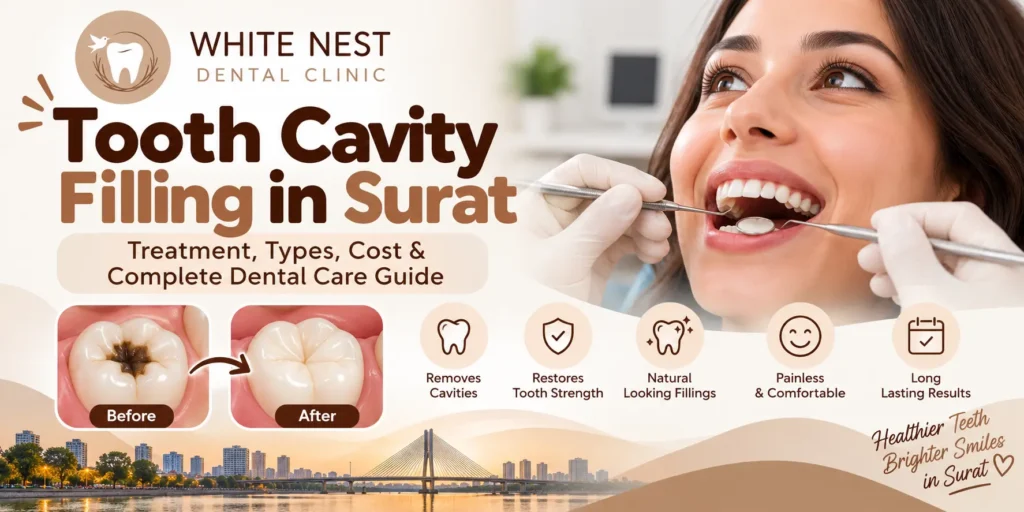
A small cavity may not seem like a serious dental problem, especially when it does not cause pain. However, untreated tooth decay can gradually damage the enamel, reach the inner layers of the tooth and eventually require more complex dental treatment. Getting the problem checked early can help preserve more of your natural tooth structure. If you are looking for tooth cavity filling in Surat, understanding the treatment process, available filling materials, symptoms and approximate costs can help you make an informed decision. At White Nest Dental Clinic, patients from Adajan and nearby areas can seek a dental assessment to understand the condition of their teeth and the appropriate treatment options. Whether you have tooth sensitivity, a visible dark spot, food getting stuck between your teeth or discomfort while chewing, a dental examination can help determine whether you need a simple filling or another form of treatment. What Is a Tooth Cavity? A tooth cavity is a permanently damaged area that develops when bacteria in dental plaque produce acids that gradually weaken the tooth structure. This process is known as dental caries or tooth decay. Your teeth have several layers. The outer enamel protects the tooth, while the dentin underneath is softer and more sensitive. Beneath the dentin is the pulp, which contains nerves and blood vessels. When decay is limited to a small area, a dentist may be able to remove the damaged portion and restore the tooth using a dental filling. If decay progresses deeper and affects the pulp, additional treatment such as root canal therapy may be necessary. Early diagnosis is important because not every cavity causes noticeable pain in its initial stages. 10 Common Signs You May Need Tooth Cavity Filling Treatment Cavities can develop without obvious symptoms. However, certain changes in your teeth may indicate that you should schedule a dental check-up. 1. Sensitivity to Hot and Cold Foods If you experience a sharp or uncomfortable sensation while drinking cold water, tea or hot beverages, tooth decay may be one possible reason. Sensitivity can also occur due to gum recession, enamel erosion and other dental conditions. 2. Toothache or Occasional Pain A mild toothache that appears while eating or drinking may indicate developing decay. Persistent or worsening pain requires prompt dental assessment. 3. Dark Spots or Visible Holes Brown, black or dark spots on a tooth may indicate decay, although not every dark mark is a cavity. A dentist can examine the affected area and determine whether treatment is required. 4. Food Frequently Getting Stuck Between Teeth If food repeatedly gets trapped in the same area, there may be a cavity between two teeth, a damaged filling or another issue that needs examination. 5. Pain While Chewing Discomfort when biting or chewing food may indicate tooth decay, a cracked tooth, a damaged restoration or another dental problem. 6. Rough or Damaged Tooth Surface A cavity may create an uneven surface or a small hole that you can notice with your tongue. Avoid trying to clean or inspect the hole using sharp objects. 7. Bad Breath or Unpleasant Taste Food particles and bacterial buildup around damaged teeth can contribute to bad breath. Persistent bad breath should be assessed because it can have several possible causes. 8. Sensitivity to Sweet Foods Pain or sensitivity after eating chocolates, sweets or sugary foods may be associated with exposed dentin or tooth decay. 9. A Previous Filling Has Fallen Out A loose, chipped or missing dental filling can expose the underlying tooth structure. It should be examined so the dentist can decide whether it needs replacement or another restoration. 10. No Symptoms but Decay Appears During a Check-Up Some cavities are detected during routine dental examinations or dental X-rays before they cause pain. This is one reason regular dental check-ups are important. What Causes Tooth Cavities? Tooth decay usually develops through a combination of bacteria, dietary habits and inadequate oral hygiene. Some common contributing factors include: Good oral hygiene and preventive dental visits can reduce the risk of cavities, but they cannot guarantee that decay will never develop. When Do You Need a Dental Cavity Filling? A dental filling may be recommended when tooth decay has created a cavity that requires restoration. During an examination, the dentist checks the affected tooth, assesses the extent of damage and may recommend an X-ray if the decay is not clearly visible or appears to extend between teeth. A filling may be suitable when: If decay has progressed significantly, a simple filling may not be sufficient. Your dentist may discuss other options based on the tooth’s condition. Types of Dental Fillings Used for Cavity Treatment The choice of dental filling material depends on the location of the cavity, its size, the amount of remaining tooth structure, functional requirements and aesthetic preferences. 1. Composite or Tooth-Coloured Filling Composite fillings are made from a resin-based material that can be matched to the natural shade of your teeth. They are commonly used for visible teeth and suitable cavities in both front and back teeth. The material is bonded to the tooth and shaped to restore its appearance and function. Potential advantages: Composite fillings may require replacement over time due to wear, chipping or recurrent decay. 2. Glass Ionomer Cement (GIC) Filling Glass ionomer cement is another restorative material used in selected dental situations. It can release fluoride and may be suitable for certain cavities, particularly in areas where aesthetic or functional demands differ. Potential advantages: GIC may not be the preferred option for every cavity, particularly where the restoration must withstand heavy chewing forces. 3. Amalgam Filling Dental amalgam is a metal-based restorative material that has historically been used for filling cavities, particularly in back teeth. It is durable in many situations but does not match the natural colour of teeth. Its use may also be affected by patient-specific considerations and applicable local regulations or recommendations. 4. Temporary Dental Filling A temporary filling is used when the dentist needs to protect a tooth for a limited
Dental Bridge Cost In Surat: Complete Price Guide, Types And Treatment Options
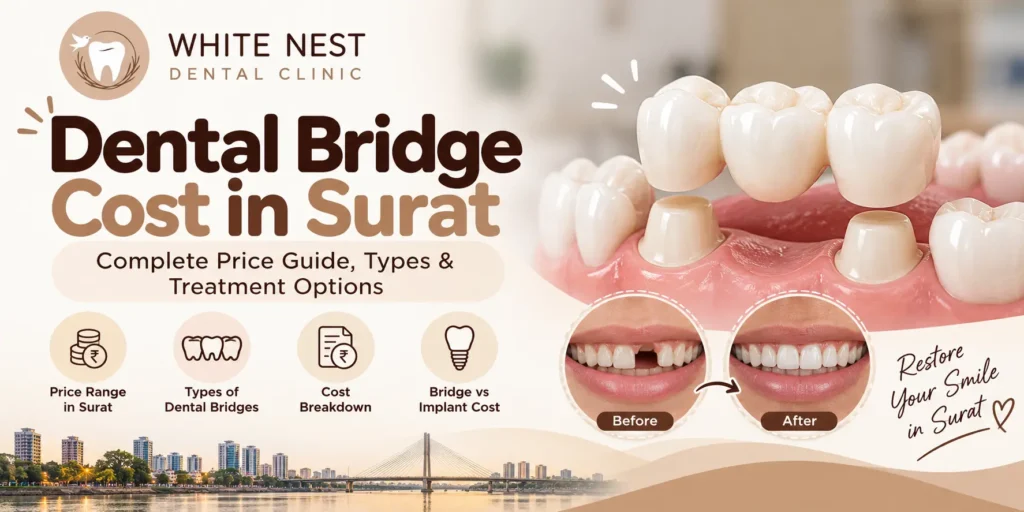
Missing one or more teeth can affect more than your appearance. It may make chewing uncomfortable, affect speech and allow neighbouring teeth to shift towards the empty space. A dental bridge is one of the fixed tooth replacement options that can help restore the appearance and function of your smile. However, before choosing treatment, most patients want to understand the Dental Bridge Cost in Surat, the available materials and what influences the final price. The cost can vary depending on the number of missing teeth, the type of bridge, material selection and the condition of the supporting teeth. At White Nest Dental Clinic, Adajan, patients can explore different dental bridge options and receive guidance according to their dental requirements. This guide explains dental bridge prices, material differences, treatment expenses and how to select an appropriate tooth replacement option. 1. What Is a Dental Bridge and When Do You Need One? A dental bridge is a fixed dental restoration designed to replace one or more missing teeth. It fills the gap using an artificial tooth, known as a pontic, supported by natural teeth or dental implants. A conventional dental bridge generally uses crowns placed over neighbouring supporting teeth, called abutment teeth, to hold the replacement tooth in position. A dentist may recommend a dental bridge if you have: A dental bridge can help restore chewing function, improve appearance and maintain the arrangement of neighbouring teeth. However, not every patient is suitable for the same type of bridge. The dentist must examine the supporting teeth, gum health, bite and available space before recommending treatment. 2. How Much Does a Dental Bridge Cost in Surat? The dental bridge price in Surat depends on the material, number of units, restoration design and additional procedures required before placement. At White Nest Dental Clinic, the currently published indicative price ranges for common three-unit bridges are: Dental bridge type Indicative cost 3-unit PFM dental bridge ₹12,000–₹24,000 3-unit Zirconia dental bridge ₹24,000–₹45,000 3-unit all-ceramic dental bridge ₹24,000–₹45,000 These are indicative ranges, not a guaranteed quotation. The final cost is determined after a dental examination and confirmation of the selected material and treatment requirements. Why Is a Three-Unit Dental Bridge Different from a Single Unit? Understanding dental bridge units is important when comparing treatment prices. For example, if one tooth is missing and two neighbouring teeth are used as supports, the restoration generally consists of: This is called a three-unit dental bridge. If multiple teeth are missing, the bridge design and number of supporting units may change. Therefore, a price quoted per unit should not be confused with the complete cost of the bridge. For a personalised estimate, the dentist must assess the number of missing teeth and the supporting structures. 3. Dental Bridge Cost Based on Different Materials Dental bridges are available in different materials. Each material has its own characteristics in terms of appearance, strength, suitability and cost. The right material depends on the location of the missing tooth, bite pressure, aesthetic expectations and the condition of neighbouring teeth. 3.1 PFM Dental Bridge Cost PFM stands for Porcelain-Fused-to-Metal. This type of bridge combines a metal framework with an outer porcelain layer designed to resemble natural teeth. Key features of PFM bridges: At White Nest Dental Clinic, the indicative cost of a three-unit PFM dental bridge is ₹12,000–₹24,000, subject to examination and material confirmation. 3.2 Zirconia Dental Bridge Cost Zirconia is a ceramic material known for its strength and natural-looking appearance. It is frequently considered for patients who want a metal-free dental restoration. Key features of zirconia bridges: Zirconia may be an appropriate choice when both strength and appearance are important. However, the final selection should be based on the patient’s bite and restoration requirements. The indicative cost of a three-unit zirconia bridge at White Nest Dental Clinic is ₹24,000–₹45,000. 3.3 All-Ceramic and E-Max Dental Bridge Cost All-ceramic bridges are designed to provide an aesthetic restoration without a metal framework. E-Max is a lithium disilicate glass-ceramic material known for its translucency and aesthetic qualities. Its suitability depends on the restoration design and clinical requirements. Key features: All-ceramic options may be particularly relevant when appearance is a major consideration. The indicative three-unit all-ceramic bridge price at White Nest Dental Clinic is ₹24,000–₹45,000, depending on the selected material and complexity. 3.4 Maryland Dental Bridge Cost A Maryland bridge, also known as a resin-bonded bridge, uses a replacement tooth attached to small wings that bond to the back surfaces of neighbouring teeth. Unlike a conventional bridge, it generally requires less preparation of the supporting teeth. Its features include: The price depends on the framework material, design, laboratory fabrication and clinical suitability. 3.5 Implant-Supported Dental Bridge Cost An implant-supported bridge is anchored to dental implants placed in the jawbone rather than relying on natural teeth on either side of the gap. This option may be considered when several adjacent teeth are missing. Key features: The total cost depends on the number of implants, implant components, bridge material, surgical requirements and whether bone grafting is needed. You can also explore Dental Implants in Surat to understand alternative tooth replacement options. 4. What Is the Cost of a 3-Unit Dental Bridge? A three-unit dental bridge is commonly used to replace one missing tooth with two supporting crowns. For example, if you have lost a first molar and the neighbouring teeth are suitable for support, a three-unit bridge may be considered. The estimated White Nest Dental Clinic pricing is: Material Three-unit bridge estimate PFM ₹12,000–₹24,000 Zirconia ₹24,000–₹45,000 All-ceramic ₹24,000–₹45,000 The actual estimate depends on the selected material, condition of supporting teeth and any additional treatment. Before proceeding, ask whether the quotation includes temporary restorations, laboratory charges, fitting and follow-up adjustments. 5. What Factors Affect Dental Bridge Cost in Surat? Two patients requiring dental bridges may receive different treatment estimates even if they have a similar number of missing teeth. Here are the major factors that influence the final dental bridge cost in Surat. Number of Missing Teeth Replacing one missing tooth may require a
Invisible Braces In Surat: A Complete Guide To Straighter Teeth Without Metal Braces

Want to straighten your teeth but don’t like the appearance of traditional metal braces? Invisible braces offer a discreet orthodontic option for people who want to improve their smile without wearing noticeable metal brackets and wires. Whether you have crooked teeth, gaps, mild crowding or certain bite alignment concerns, modern orthodontic treatments may provide suitable solutions depending on your dental condition. If you are searching for Invisible Braces in Surat, understanding how these treatments work, their benefits, limitations and cost factors can help you make an informed decision. At White Nest Dental Clinic, Adajan, patients can explore orthodontic treatment options, including clear aligner solutions, based on their individual dental requirements. In this guide, we explain everything you should know before choosing invisible braces, from treatment suitability and daily maintenance to expected treatment duration and the importance of professional orthodontic supervision. 1. What Are Invisible Braces and How Do They Work? Invisible braces are orthodontic solutions designed to straighten teeth with less visible appliances than conventional metal braces. The term can refer to different treatment options, including clear removable aligners and lingual braces. However, clear aligners are among the most commonly discussed options when people search for invisible teeth braces. Clear aligners are custom-made transparent trays that fit over your teeth. They apply controlled pressure to gradually move teeth towards their planned positions. Unlike traditional braces, clear aligners do not use visible metal brackets or wires. Instead, patients receive a series of trays, with each set designed to make specific tooth movements. How Do Clear Aligners Straighten Teeth? The process generally involves: The exact treatment process depends on the aligner system, the complexity of the case and the orthodontist’s recommendations. 2. Types of Invisible Braces Available Not all invisible braces work in the same way. The appropriate option depends on the patient’s orthodontic condition, aesthetic preferences, lifestyle and treatment goals. 2.1 Clear Aligners Clear aligners are transparent, removable trays designed to gradually reposition teeth. They are custom-made for each patient and replaced according to the treatment schedule. Key features of clear aligners: Clear aligners may be suitable for selected cases involving crowding, spacing and certain bite concerns. Explore Clear Aligners and Invisalign in Surat to learn more about available orthodontic options at White Nest Dental Clinic. 2.2 Invisalign Treatment Invisalign is a branded clear aligner system that uses a series of custom-made transparent trays to move teeth gradually. It involves digital treatment planning and individually designed aligners. The orthodontist evaluates the patient’s dental condition before determining whether Invisalign is an appropriate treatment option. Invisalign may be considered for certain cases involving: Not every orthodontic condition can be treated with Invisalign alone. Some cases may require attachments, additional orthodontic appliances or alternative treatment approaches. 2.3 Lingual Braces Lingual braces are fixed orthodontic appliances attached to the inner surfaces of the teeth, facing the tongue. Since the brackets are positioned behind the teeth, they are not easily visible when a person smiles. Unlike clear aligners, lingual braces are not removable by the patient. They are customised and require specialist planning. They may be an option for patients who want fixed orthodontic treatment without visible brackets on the front surfaces of their teeth. 3. Who Is a Good Candidate for Invisible Braces? Invisible braces can be suitable for many teenagers and adults, but treatment eligibility depends on individual dental conditions. A proper orthodontic examination is necessary before starting treatment. You may be a potential candidate if you have: Crooked Teeth Teeth that overlap, rotate or appear uneven may sometimes be corrected using clear aligners. Gaps Between Teeth Spaces between teeth can sometimes be reduced through controlled orthodontic movement. Mild to Moderate Crowding When there is insufficient space in the dental arch, teeth may overlap or appear crowded. Selected cases can be managed with aligner-based treatment. Certain Bite Problems Some bite conditions, including selected overbite, underbite and crossbite cases, may be managed using clear aligners with appropriate planning. Relapse After Traditional Braces People whose teeth have shifted after previous orthodontic treatment may sometimes benefit from a new aligner treatment plan. Adults Looking for Discreet Treatment Working professionals and adults who prefer a less noticeable orthodontic appliance may find clear aligners convenient. Who may not be suitable? Patients with complex jaw discrepancies, severe skeletal problems, significant periodontal disease or certain difficult tooth movements may need alternative or combined orthodontic treatment. The orthodontist should determine the safest and most predictable approach after examining the patient. 4. What Dental Problems Can Invisible Braces Help Correct? Invisible braces are designed to address selected tooth alignment and bite concerns. Some common orthodontic conditions include: Crowded Teeth Crowding happens when teeth do not have sufficient space to align properly. It may cause overlapping and make brushing and flossing more difficult. Gaps Between Teeth Spaces between teeth may occur because of differences in tooth size, jaw dimensions or other dental factors. Overbite An overbite occurs when the upper front teeth overlap the lower front teeth vertically more than expected. Underbite An underbite occurs when the lower front teeth sit ahead of the upper front teeth when the mouth closes. Crossbite A crossbite occurs when certain upper teeth sit inside the lower teeth instead of outside them. Mild Tooth Rotation Some rotated teeth can be corrected through carefully planned orthodontic movement. The suitability of invisible braces depends on the severity of each condition. A clinical examination is essential to determine whether aligners alone can achieve the desired result. 5. Invisible Braces vs Traditional Metal Braces: Which Is Better? Both invisible braces and conventional braces can help correct teeth alignment, but they differ in appearance, maintenance and treatment requirements. Comparison Invisible Braces Traditional Metal Braces Appearance Transparent and discreet Visible metal brackets Removability Usually removable in clear aligner systems Fixed throughout treatment Eating Removed during meals Certain hard and sticky foods may need to be avoided Cleaning Remove trays to brush and floss Requires cleaning around brackets and wires Compliance Requires consistent patient cooperation Fixed appliance Adjustments New aligners according to the treatment
Cavity Treatment For Kids In Surat: A Complete Guide For Parents

Noticing a black spot, small hole or unusual sensitivity in your child’s teeth can be worrying for any parent. Dental cavities are common during childhood and can develop when bacteria in the mouth break down sugars and produce acids that damage tooth enamel. If left untreated, tooth decay may progress, causing toothache, infection and difficulty eating. Finding the right Cavity Treatment for Kids in Surat at an early stage can help protect your child’s oral health and prevent more complicated dental problems. At White Nest Dental Clinic, Adajan, parents can seek professional dental assessment and guidance for children’s oral health concerns, including tooth decay and cavities. 1. Why Do Children Develop Dental Cavities? Children can develop cavities because their teeth are exposed to sugary foods, frequent snacking, sweetened drinks and plaque-producing bacteria. Young children may also find it difficult to brush every tooth properly without parental supervision. Some common causes of tooth decay in children include: Parents should understand that cavities are not caused by eating one chocolate or sweet occasionally. The frequency of sugar exposure, oral hygiene habits and individual cavity risk all play important roles. 2. Common Signs Your Child May Have a Cavity Children do not always complain about dental problems during the early stages of tooth decay. Parents should watch for visible changes and unusual behaviour related to eating or brushing. Look out for these warning signs: White, Brown or Black Spots Early tooth decay may appear as chalky white marks on enamel. As the cavity progresses, brown or black spots and visible holes may develop. Tooth Sensitivity Your child may experience discomfort when eating cold, hot or sweet foods. Sensitivity can indicate that the tooth needs professional examination. Toothache or Pain While Eating If your child complains about pain while chewing, it could be related to a cavity or another dental problem. Food Getting Stuck Between Teeth Food repeatedly collecting in one particular area may indicate a cavity or an area where the tooth structure has changed. Swelling Around the Gums Swelling, a gum boil, pus or facial swelling can indicate infection and requires prompt dental attention. Difficulty Sleeping or Eating Some children become irritable, avoid chewing on one side or have difficulty sleeping because of dental discomfort. Important: A cavity can exist without noticeable pain. Parents should not wait until their child develops a toothache before arranging a dental checkup. 3. Why Is Treating Cavities in Baby Teeth Important? One common misconception among parents is that cavities in milk teeth do not require treatment because these teeth will eventually fall out. However, primary teeth play several important roles in childhood development. They help children chew food, support speech development and maintain the space needed for permanent teeth to emerge. Untreated tooth decay in baby teeth may lead to: The correct baby teeth cavity treatment depends on the child’s age, the location of the affected tooth, the extent of decay and how close the tooth is to its natural shedding time. A dentist can determine whether the tooth needs monitoring, preventive treatment, a filling, pulp treatment or another appropriate procedure. 4. Different Stages of Tooth Decay in Children Understanding how cavities develop can help parents recognise why early dental examinations matter. Stage 1: Early Enamel Demineralisation The earliest signs may appear as white or chalky patches on the tooth surface. At this stage, the enamel has started losing minerals, but a physical hole may not have formed. Depending on the clinical findings, fluoride treatment, improved brushing habits and dietary changes may help manage early lesions. Stage 2: Enamel Cavity As the decay progresses, the enamel may break down and form a small cavity. A dentist will examine the affected area and determine whether a filling is needed. Stage 3: Dentin Decay When decay reaches the dentin beneath the enamel, the tooth may become more sensitive. A dental restoration may be recommended to remove or manage the damaged area and restore the tooth. Stage 4: Deep Tooth Decay If decay approaches or reaches the dental pulp, the child may experience significant pain or infection. Depending on the condition of the tooth, pulp therapy or another treatment may be necessary. Stage 5: Dental Infection Advanced decay can sometimes result in an abscess, swelling or infection around the tooth. Prompt dental assessment is important to determine the appropriate treatment. 5. What Are the Treatment Options for Kids Cavities? The right kids cavity treatment in Surat depends on the child’s dental examination and the severity of tooth decay. Not every cavity requires the same procedure. Here are some treatment options a dentist may consider. 5.1 Fluoride Treatment for Early Tooth Decay Professional fluoride treatment may be recommended when tooth decay is detected at an early stage and the enamel has not developed a cavity. Fluoride helps strengthen tooth enamel and supports remineralisation. The dentist will assess the child’s cavity risk and determine whether professional fluoride application is appropriate. It is important to understand that fluoride treatment cannot rebuild a tooth once a substantial physical cavity has formed. 5.2 Dental Fillings for Children’s Cavities A dental filling is commonly used when a cavity has damaged part of the tooth structure. During treatment, the dentist assesses the affected tooth, removes or manages the decayed portion as clinically appropriate and restores the area using a suitable dental filling material. Dental fillings for kids can help: The filling material and treatment approach depend on the child’s age, tooth location, extent of decay and cooperation during the procedure. 5.3 Silver Diamine Fluoride (SDF) Treatment Silver diamine fluoride is a professionally applied liquid that may be used to arrest certain active cavities. It can be considered in selected cases, particularly when a minimally invasive approach is appropriate. However, parents should understand that SDF commonly causes permanent black staining of the treated decayed area. It does not restore the original shape of the tooth, and continued monitoring is necessary. The dentist will explain its suitability, limitations and alternatives before recommending it. 5.4 Pulp Treatment for